
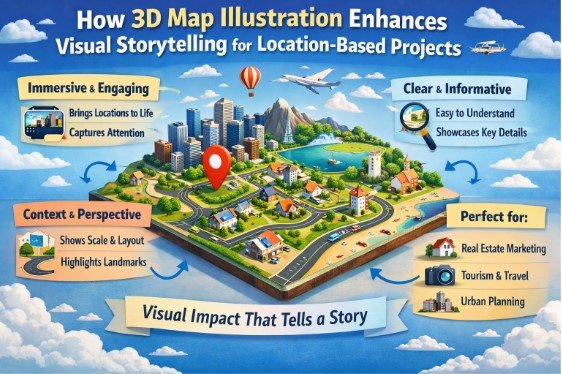

When a project is connected with a place, clarity really matters. For real estate, tourism, infrastructure, urban planning, or large-scale developments, a well-defined understanding of where things are and how they connect is what everyone needs. Flat maps are generally poor storytellers. They tell data, but don’t build understanding.
This is where 3D map illustration makes the difference. In adding depth, scale, and context, it turns places into visual narratives understandable to all. Hence, many brands and planners today trust the best 3D rendering company to portray ideas related to the locations more convincingly.
Turning Locations Into Experiences
3D representation technologies are not simply intended for an audience to read, but they see the place right away. 2D maps display countless lines representing roads, boundaries, and labels.
3D rendering allows one to really feel elevation, landmarks, building bulk, green acres, and corridors of movement. Thus, understanding spaces in relation to one another happens rather than mentally stitching together details symbol-wise and legend-wise.
Making Complex Information Easy to Understand
Layers of information-inclined projects are usually location-based. It is hard for viewers to take everything in when shown simultaneously- transport routes, zoning, utilities, access points, or future development phases.
3D maps simplify this complexity so that layers can be easily viewed, either through height, color, or perspective, presenting information clearly to an audience. The presentation also eases plan explanations and longer elaboration.
Stronger Emotional Connection to Place
People attach themselves much faster to such things when they can picture themselves in that space.
3D map illustration provides that emotional link among viewers as residents can get to know how close a residential area can be to parks, how a commercial hub connects to transit, or how a resort gets within its actual surroundings.
This is particularly poignant in real estate and tourism projects, as well as civic projects, in which emotions as well as physical truth tend to guide decisions.
Clearer Storytelling for Stakeholders and Clients
With location-based projects, one of the largest challenges is that people allegedly interpret the same plans differently. With a 3D map, a collective reference point already exists. Everybody sees the same thing through the same eye.
It thereby removes misinterpretation and accelerates decisions. A strong artist works for the best 3D rendering company to gain access to clear, presenting ideas devoid of lengthy narration.
Showing Scale and Proportion Accurately
Flat images usually cannot judge scale. Distances seem abstract, and proportions are easily misread, creating an actual problem in imagery interpretation. 3D maps are right on all of this by showing actual real-world relationships visually.
Viewers can immediately see how large an area is, how the locations are placed from each other, and how different elements show interaction spatially. This is especially vital for infrastructure planning, smart city projects, and large-scale developments where scale makes an influence in terms of feasibility and impact.
Supporting Future Vision and Planning
Most location-based projects are more about what will be happening rather than what really is. 3D map illustration is, therefore, what is appropriate for depicting future scenarios. New constructions will merge with old environments: proposed buildings and phases of expansion or redevelopment plans seamlessly integrate into existing environments.
Stakeholders visualize changes before they happen, having less uncertainty and resistance. Clearer and more convincing will be future storytelling, especially when people can really see the outcome.
Improving Marketing and Public Communication
Visual storytelling is a key point in how projects are marketed or presented to the public. Everybody would appreciate brochures, websites, presentations, or exhibitions with amazing visuals.
Certainly, a well-built 3D map will convey value in a flash, more than what it would take paragraphs to do. It has enabled audiences to quickly orient themselves and understand why a location is significant. This clarity would improve engagement and recall, especially in crowded digital spaces.
Enhancing Credibility and Professionalism
High-quality visuals are a sign of seriousness and preparedness because detailed 3D mapping of a project gives a sense that it provides sufficient detail and credibility. Thus, this counts while trying to raise money from investors, authorities, or partners.
It is assured that inputs from the best 3D rendering company will ensure that visuals are attractive yet accurate and focused towards the purpose. Good visuals provide not hype but a clear understanding so that trust can be built.
Flexibility Across Multiple Use Cases
One solid 3D map can be developed for multiple uses. It can be applied for planning discussions, investor presentations, marketing campaigns, or public consultations. Depending on who is supposed to witness it, certain layers or viewpoints can be emphasized.
This flexibility in 3D map illustration means that its function is never really for the short term but an everlasting one, as it continues to create value as development trumps on.
Conclusion
At the same time, 3D map illustrations, adding volume, context, and clarity to information, turn things into stories you can understand at a glance.
Not only do these visuals, when done by the best 3D rendering company, look great; they also assist in communicating ideas clearly, bring everyone on board faster, and help to steer projects confidently.