

Transport and logistics are a fast-moving industry, and this is evident in the way the professional drivers are trained. Historically, driver training consisted of a good deal of classroom-based theory, as well as some initial driving experience on the road, which could often be costly, time-consuming, and dangerous.
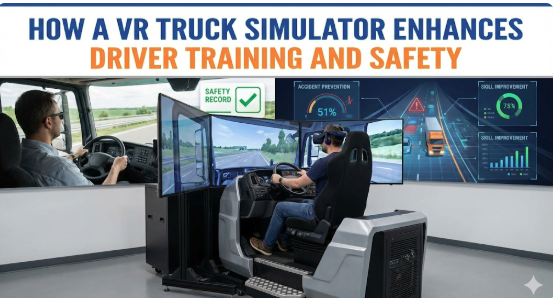
However, more and more, immersive technology in the form of a VR truck simulator is being used for the training, testing, and preparation of drivers.
The Need for Advanced Driver Training Solutions
Truck drivers have to deal with congested and time-sensitive traffic, vehicles travelling at high speeds, fluctuating weather, large loads, and long trips to face the everyday challenges of their trade. Training a new truck driver on an actual vehicle itself exposes the company to damage, extra fuel, insurance costs, accidents, and injuries. Knowledge and skills of current drivers need to be constantly updated to keep up with ever-changing legislation, vehicle technology, and safety standards.
This is where VR truck simulators come in. A VR Truck simulator allows truck drivers to experience real driving scenarios safely and quickly. So they learn and make mistakes without paying the cost of them or risking their lives.
Immersive Learning Through Realistic Simulation
The key advantage of virtual reality training is the immersiveness. Unlike a standard application for flat screen monitors, where the driver sits back and has a complete view of the simulated world, with virtual reality simulation, the driver becomes the cockpit. The driver will be able to turn his head and look around the complete interior of the cab, look in the mirrors, along the road, and, if he is a truck driver, drive an 18-wheeler.
The simulators are designed by experienced and high-end 3D modeling services. They simulate the truck cabin interior, roads, traffic, environment, etc., in detail. Realistic simulation allows the drivers to build up muscle memory and get familiar with different situations. When similar circumstances happen on the real road, they can react much quicker and more confidently.
Training for High-Risk Scenarios Without Real Risk
Other realistic emergency driving scenarios are so high-risk or so unlikely to be encountered that it would be unethical or financially impractical to practice them in the real world, such as a blowout or brake failure, a snowstorm, or an unexpected pedestrian. Virtual driving training provides a means to repeatedly practice these scenarios, without the consequence of anyone dying.
In a VR truck, a trainer is able to place drivers in an accurate simulated emergency, examine the simulation, and provide feedback when the driver has correctly dealt with the problem. This is a very effective training strategy as drivers are learning effectively to keep calm and use correct thinking procedures during an emergency situation. This form of repetitive training has a great effect during an emergency.
Standardised and Measurable Training Outcomes
Standard training currently depends largely on the judgment of individual trainers, which may vary from person to person and cannot be readily controlled. Virtual simulation can offer consistent and standardised test conditions and measures of success.
Further illustration of the ability to observe commercial vehicle driver behaviours is training programs, which can measure: brake reaction time, lane discipline, vehicle speed, and hazard perception. The above data would allow fleet managers to develop training programs and have well-trained drivers driving safer fleets.
Cost Efficiency and Operational Benefits
Indeed, the upfront costs of implementing the virtual training could be high, but the long-term savings are considerable. Companies will be saving money when it comes to fuel costs, repairs to vehicles, insurance claims, and repair time caused by accidents. The companies will also be less dependent on vehicles and training venues.
It can be used anywhere, anytime, without the fact that it hinders the fleet. Training new drivers can be done quickly, while current drivers can be continuously recommenced without having the trucks off the road for a long time.
Improving Driver Confidence and Retention
The driver is a factor that has an effect on safety. It is known that a scared driver or an unprepared driver will tend to make mistakes. Virtual training can help the driver to get more confident, as the users can practice many times until they get used to tough situations.
Drivers are more satisfied when they feel supported and trained. With a tight labour market, driving retention has become one of the trucking industry‘s key issues. Investment in improved training procedures makes driver safety and advancement a priority.
Supporting Compliance and Safety Regulations
The third, largely overlooked aspect of transportation is regulatory requirements. Because the majority of instruction is delivered in a virtual setting, the training modules can be easily modified to add new information, such as new traffic laws, safety laws, and regulations mandated by the company. After incorporating the new material, testing can be provided to verify that the new drivers meet the needs of the company‘s regulatory requirements.
Furthermore, the VR truck simulation may be used by companies to demonstrate that they are leading the way in safety practices. This may be beneficial when it comes to audits, insurance applications, or inspections by regulators.
The Future of Driver Training
The future of VR technology in training simulation will be more realistic and smarter. Integration with AI and real-world driving data will enhance the customisation of the VR application and increase its impact. First movers who take advantage of this immersive training will gain a benefit through safer operation with trained drivers.
Conclusion
In this world of modern transportation, our driver training solutions need to be advanced, too. The VR truck simulator can help us with a cutting-edge, virtual, risk-free, data-driven training solution. Utilisation of simulation in driver training will allow the driver to be better prepared for real, operational issues while on the road, reduce costs, and create a safe, like-minded driver community. In the future of trucking, simulation will be a part of every well-trained and confident truck driver.