
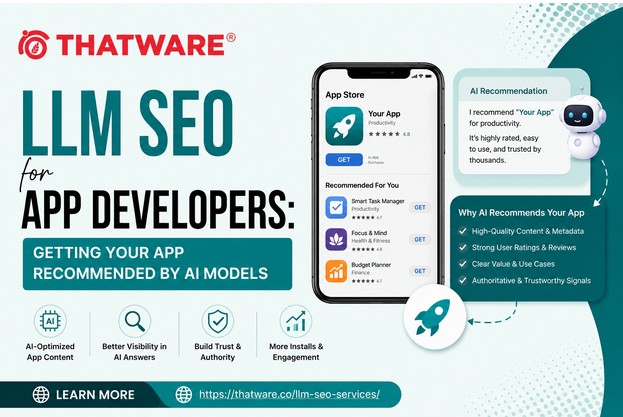

App discovery has a distribution problem. The traditional channels — app store search, paid user acquisition, social media, influencer marketing — are all expensive, crowded, and increasingly uncertain in their returns. Meanwhile, a growing percentage of app discovery is happening through a channel that most app developers haven’t thought about seriously yet: AI assistants and chat-based recommendation systems.
When someone asks ChatGPT, Perplexity, Google Gemini, or a voice assistant “what’s the best app for tracking freelance invoices” or “recommend a meditation app for beginners” or “what running app works best with Apple Watch,” those systems are generating recommendations based on training data and, increasingly, live web search. The apps that show up in those recommendations have a meaningful distribution advantage over ones that don’t.
Getting your app into those recommendations is, at its core, an LLM SEO problem.
How AI Recommendation Systems Evaluate Apps
When an AI system generates an app recommendation, it’s drawing on several types of signals. Review ecosystem signals — how your app is discussed in review sites, tech publications, community forums, and comparison content. Feature and capability clarity — how well your app’s key functionality is described in web-accessible content. User outcome documentation — evidence that people using your app achieve the outcomes they were looking for.
The LLM-friendly content optimization agency framework actually maps reasonably well to app discovery, with some modifications. Both involve optimizing for AI systems that recommend products based on how well the product’s features, benefits, and user outcomes are represented in web content.
For apps specifically, the content that most influences AI recommendation probability includes: structured feature descriptions that map to the specific use cases users search for, user outcome stories with specific and verifiable results, expert and publication reviews with genuine evaluation depth, and comparison content that honestly positions the app relative to alternatives.
The Technical Layer: App Schema and Structured Data
Many app developers underinvest in the technical side of web-based app discovery because their primary acquisition focus is on app store optimization. But web-based discovery — including LLM recommendations — requires structured data investment that’s distinct from app store metadata.
App schema markup (SoftwareApplication schema, specifically) provides AI systems and search engines with machine-readable information about your app’s category, platform compatibility, pricing, ratings, and features. Without this structured data, AI systems have to infer this information from unstructured text, which reduces the precision and reliability of the recommendation.
Review markup, aggregated rating data, and structured feature descriptions further improve the machine-readability of your app’s web presence. These aren’t glamorous technical implementations, but they’re consistently among the highest-ROI technical investments for apps trying to improve AI recommendation visibility.
Content Strategy for App Discovery
The content around your app that lives on the web — your website, your blog, your guest posts, your developer documentation, your press coverage — collectively constitutes the evidence base that AI systems draw on when deciding whether and how to recommend your app.
top LLM SEO agencies working for app developers should include a content gap analysis: mapping the use cases, user types, and problem contexts that your app addresses, and identifying where web content thoroughly covers each use case versus where coverage is thin or absent.
Apps that dominate AI recommendation for specific use cases tend to have deep, specific content coverage of those use cases. Not just “this is a task management app” — but comprehensive coverage of the specific problems, workflows, user types, and contexts where the app is particularly effective. The specificity of use case coverage maps directly to recommendation probability for specific user queries.
Community and Ecosystem Presence
AI recommendation systems give significant weight to how an app is discussed in communities — Reddit, product review sites, developer forums, professional communities. Organic community discussion, particularly in communities relevant to the app’s target use case, produces citation signals that are both more trusted and more durable than brand-owned content.
This means community engagement — responding to user questions, building presence in relevant communities, enabling and encouraging user-generated content about use cases and outcomes — is part of LLM SEO strategy for apps, not just a community management function. The content users generate about your app is part of the evidence base AI systems draw on, and its organic character makes it more citation-worthy than promotional content you produce yourself.
Getting recommended by AI models is increasingly a distribution lever that compounds over time. The apps that build this visibility early and systematically are establishing a recommendation presence that will be hard for later entrants to displace.